Why Are Customers Signing Up but Not Completing Onboarding?
So many customers sign up, poke around for a minute, then just vanish before finishing setup. Usually, onboarding asks too much too soon, or it just doesn't give people a clear reason to keep going.
You end up with a pile of "signed up" accounts that never become real users. I'm Jonny Quirk, founder of Community Rocket. I work with SaaS, subscription, and tech businesses on customer-led growth, retention, and advocacy. This drop-off pattern? I see it all the time.
It's rarely just one broken button or a missing feature. Most often, it's unclear next steps, too much friction early on, and no real sign that the customer is making progress.
Let's look at how to spot early warning signs of a broken onboarding flow, what usually causes it, and how to check your numbers to see where people get stuck. You'll get practical fixes you can try in the next 30 to 90 days, plus a real example from the field.
Key Takeaways
When customers sign up but don't finish onboarding, they're usually saying the process is too slow or unclear…not that they don't want your product.
Tracking metrics like time-to-value and drop-off points shows you exactly where customers lose interest.
Small, targeted tweaks to onboarding can turn more signups into active, paying customers who stick around and refer others.
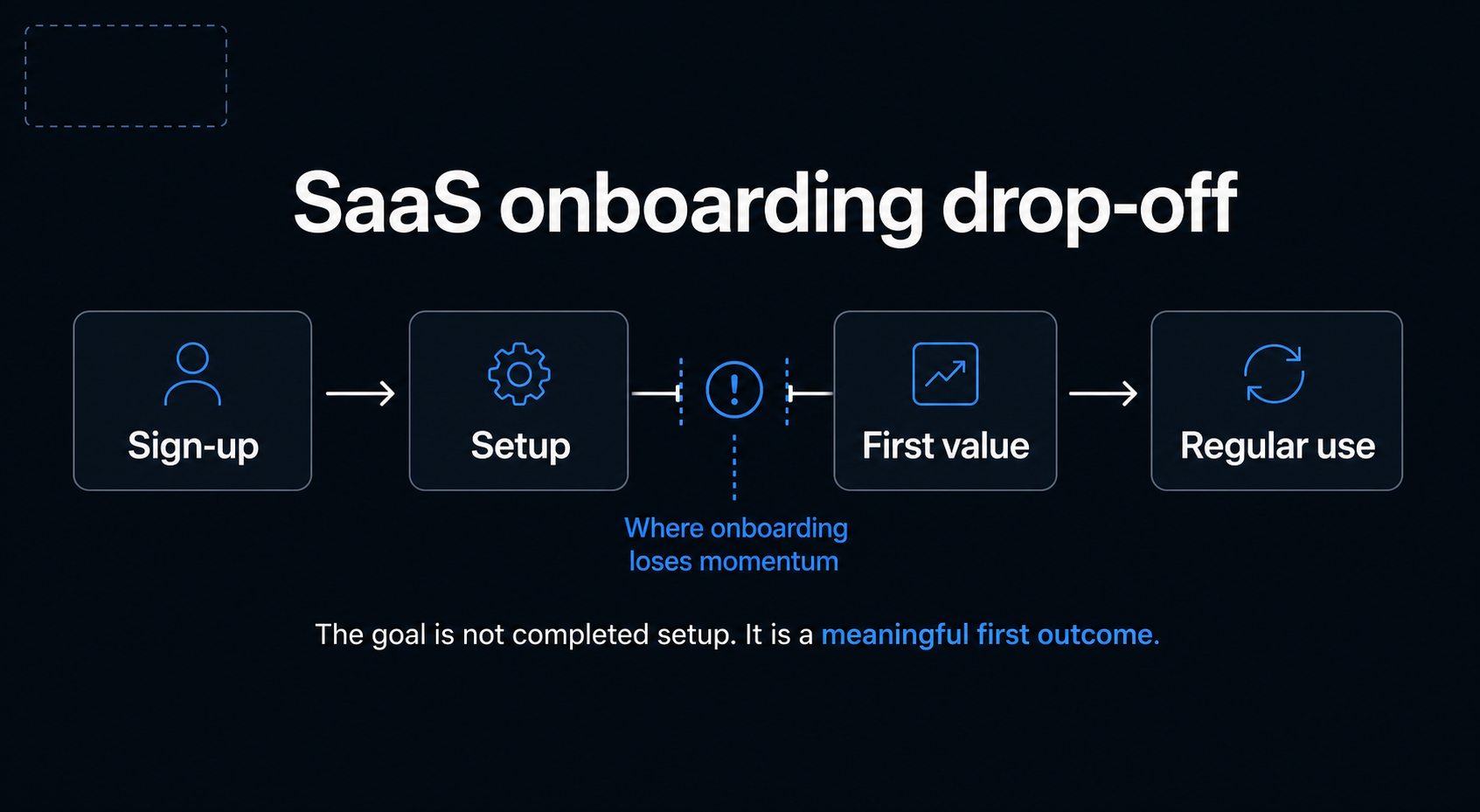
The important onboarding milestone is not completed setup…it is a meaningful first outcome.
The Onboarding Completion Gap and Why It Matters
The onboarding completion gap is the space between someone signing up and someone actually finishing your onboarding process. That gap is where most silent churn starts.
A customer signs up, pokes around for a few days, then drifts off. They don't cancel; they just stop bothering. In many SaaS businesses I've worked with, nobody notices until renewal time, when it's too late.
You can measure this gap with one simple number: your onboarding completion rate. That's the percentage of new customers who finish the steps you've defined as "onboarded."
If you haven't defined this yet, that's your first job. What does a finished onboarding actually look like for your product? Three key actions? A specific feature used? A team member invited?
Get specific. Vague onboarding success criteria lead to vague results.
Here's why this matters for your business, not just operations:
Low completion rates predict churn before it hits your revenue.
They hide in your data if you only track sign-ups and cancellations.
They're fixable, often faster than you'd think, once you know where people drop off.
I've seen teams assume onboarding works because support tickets are low. But low ticket volume often means people just gave up, not that they're happy. Track completion, not just support volume.
Common Signs Your Onboarding Is Not Working
If customers sign up, finish setup, then go quiet, your onboarding isn't working. That silence is a huge warning sign.
Here are the patterns I see most when reviewing SaaS onboarding:
High drop-off during signup. People abandon halfway through because something's asking too much too soon.
Users log in once, never return. They finished the tasks but never found a reason to come back.
Low activation on core features. Customers set up an account but never touch the features that matter.
Support tickets spike after onboarding "finishes". Usually, people are confused, not satisfied.
No clear owner checks in on outcomes. If you only track whether steps were completed, not whether the customer got value, you'll miss onboarding that looks finished but isn't.
I've watched businesses treat onboarding as a checklist. They tick boxes, mark it done, and move on. But ticking boxes isn't the same as delivering a good customer experience.
Can you name the accounts that completed onboarding but haven't used the product in the last two weeks? If not, you've got onboarding issues hiding in plain sight.
A good onboarding experience means customers reach a specific outcome, not just a set of completed steps.
Root Causes in SaaS, Subscription and Tech Businesses
Onboarding usually fails when the product asks for effort before showing any value. You've sold the outcome, but setup gets in the way.
I've seen this happen over and over in B2B SaaS. The sales team closes the deal on a promise, then hands the customer to a generic setup flow that doesn't match what was pitched. That gap between expectation and reality breaks trust fast.
Some common causes show up everywhere:
Too much configuration up front. Asking users to set integrations, permissions, and preferences before they've seen any benefit.
No clear first win. Users don't know what "success" looks like in week one, so they drift.
Generic onboarding for different user types. A finance admin and a marketer need different first steps, not the same generic tour.
Unclear data handling. If onboarding asks for sensitive info without explaining why, or skips data privacy and GDPR/CCPA…users hesitate.
Does your onboarding match your ideal customer, or is it built for an "average" user who doesn't really exist?
In a lot of subscription businesses, the fix isn't more features or automation. It's just making the first session simple, so customers get value fast, fewer decisions, less friction.
How to Diagnose Your Customer Lifecycle
Map out every stage a customer goes through, from sign-up to renewal. See where they get stuck. Onboarding is just one link in a longer chain, and problems often start before the customer even logs in.
Pull your data. Check your CRM. How do customers move through onboarding? Where do most people drop off? Which steps take the longest?
Ask yourself:
Do customers know what they're supposed to do next?
Are onboarding tasks actually matched to customer needs, or just what your product team thinks they need?
Is there a clear workflow, or does it change depending on who's handling the account?
One SaaS client had a five-step process that looked simple, but user feedback showed step three confused nearly everyone. That one step caused most of the drop-off.
Talk to customers directly. Send short surveys after each onboarding stage, or better yet, hop on a call with a few recent sign-ups. Ask what almost made them quit.
Compare customer needs to what onboarding actually delivers. If those don't match, that's probably why people sign up but never finish setup.
If you want a structured way to check this, a customer growth and retention audit can help you spot exactly where customers are falling away.
Key Metrics and Signals to Review First
Before you fix anything, check your onboarding completion rate. That's the percentage of new customers who finish onboarding, your clearest signal if something's broken.
Next, look at time to first value (TTFV). How long does it take a customer to get their first real win in your product? In my experience, a slow TTFV is the biggest reason people drop off before finishing setup.
Check your progress tracking data. Where do customers stop? Is it always one step, or does drop-off happen gradually? If most people stall at the same point, that's your answer.
Pull in your product analytics too. What customers do inside your product is often more honest than what they say in a survey.
Ask yourself:
What percentage of customers complete onboarding within your target window?
How long does it take the average customer to reach their first meaningful outcome?
Which step has the highest drop-off rate?
Connect this back to retention and satisfaction. If customers who finish onboarding stick around longer and rate you higher, that proves onboarding completion matters for your business, not just as a vanity number.
Practical Fixes for the Next 30–90 Days
Fix the biggest drop-off point first. Then work through the rest.
You don’t need a full onboarding overhaul to see results. Small, targeted changes usually move the needle faster than a total rebuild.
Start by mapping your onboarding flow. Find the exact step where people leave.
If you don’t have this data yet, make that your week one task. Add progress indicators or progress bars so users know how far they’ve got and what’s left.
I’ve seen simple percentage counters cut drop-off on their own. It’s a quick win.
Next, check your documentation and tutorials. Are they written for someone who already knows your product, or a total beginner?
Tools like Scribe or Loom let you create step-by-step guides and short video tutorials without a design team. That saves time and gets real users unstuck faster.
Consider adding a customer success manager or CSM for higher-value accounts. A bit of proactive communication in the first fortnight can make a real difference to whether someone finishes setup.
This doesn’t need to be a permanent hire. If you’re testing this, a short project like implementation sprints helps you build and test a proper onboarding process without committing to long-term headcount right away.
Build an onboarding checklist that breaks tasks into small, obvious wins. Use automation to trigger reminder emails when someone stalls.
A customer-facing portal where users can track their own progress also helps, especially for team-based products where several people need to complete different steps. It’s surprising how much a simple checklist can move things along.
If budget allows, look at customer onboarding software with built-in machine learning to flag at-risk sign-ups early. Good UX design and user-centric design matter here too.
Every extra field or unclear button is a reason to give up. Don’t give people excuses to bail out.
Onboarding and Time-to-Value Changes
Customers drop off during onboarding when it takes too long for them to see results. If your onboarding is slow, confusing, or generic, you’ll lose people before they ever get to that first value milestone.
I see this pattern a lot. Someone signs up, gets dropped into a generic onramp that treats every user the same, and gives up before reaching anything useful.
Time to value is one of the clearest predictors of whether someone finishes onboarding at all. It’s often overlooked in favor of flashy features or a longer feature tour.
Here’s the practical bit. Look at your onboarding flow and ask: how long does it take a new customer to hit their first genuine win?
Not a tour completion, not a tick-box task, something that actually matters to them. If you’re not sure, ask a few recent sign-ups what their first “aha” moment was.
A few things worth doing:
Map your first value milestone. Be specific about what it is for your product. For a project management tool, that might be inviting a teammate and assigning a task. For an analytics platform, it could be seeing their first real dashboard with their own data.
Personalise where you can. Personalised onboarding based on role or use case helps people get to relevant value faster than a one-size-fits-all path.
Make it interactive, not passive. Interactive onboarding, where users actually do the task rather than just watch it explained, tends to build confidence and drive product adoption faster.
If your time-to-value takes weeks instead of minutes or hours, that’s likely a big part of why people aren’t finishing. Speed matters more than most teams realise.
Retention and Lifecycle Improvements
Fixing onboarding is only half the job. You also need to build habits that keep customers around long after their first login.
I’ve watched SaaS teams treat onboarding as a one-off event. Then they wonder why customer churn spikes at month three.
Activation gets a user started. Retention keeps them paying.
Set up customer success check-ins at fixed points, not just when someone raises a support ticket. A short email at day 14 asking “how’s it going so far?” tells you far more than a dashboard ever will.
Build proper feedback loops into your product. Ask users what’s working and what isn’t, then actually act on what they tell you.
The fastest way to spot a churn risk is a customer who used to log in daily and suddenly goes quiet for a week. Don’t let that slip by.
Community forums are underused here. A space where customers can ask questions and share tips does two things: it takes pressure off your support team, and it gives you a live feed of what’s confusing people.
A few practical steps to try:
Send a value recap email showing what a customer has achieved so far
Flag accounts with dropping usage before renewal, not after
Ask one simple question in-app: “did you get what you needed today?”
Small, consistent nudges like these build the habit that keeps people paying month after month. It’s not glamorous, but it works.
Advocacy, Referrals and Customer Proof
Weak onboarding kills advocacy before it starts. If customers never reach value, they’ve got nothing good to say about you, let alone refer anyone.
I’ve seen SaaS businesses treat referrals and reviews as something to chase months down the line. That’s backwards. The seeds of advocacy get planted in week one.
Think about it from the customer’s side. Would you recommend a tool you’re still struggling to set up?
Would you leave a glowing review for something you haven’t used yet? Me neither.
Build proof into onboarding itself:
Show new customers what similar businesses have achieved, right when they’re setting up
Use short customer quotes or case studies at key onboarding steps, not just on your marketing pages
Ask satisfied customers for a quick testimonial the moment they hit their first win, while it’s fresh
It reassures new customers they’ve made the right choice. And it gives you a steady supply of proof for future sign-ups.
Don’t wait for a formal advocacy program to start collecting this. A simple in-app prompt after a customer completes a key setup step works fine.
Something like “How’s it going so far?” can surface both quick wins and early friction. Don’t overthink it.
Here’s a practical gut check: how many new customers could you name a specific outcome for in their first 30 days? If the answer’s close to zero, you don’t just have an onboarding problem. You’ve got a proof problem, and that’ll hit referrals and reviews later.
Common Mistakes to Avoid
Most onboarding drop-off comes down to a handful of mistakes you can fix without a big redesign. Asking for too much information too soon is one of the biggest.
I’ve seen sign-up forms with eight or nine fields when three would do. Stick to email, name, and company, you can ask for the rest once someone’s actually using the product.
Treating every customer the same is another big mistake. A freelancer and a 200-person marketing team don’t need the same onboarding journey.
If your flow doesn’t ask what the customer is trying to achieve, you’re guessing at what matters to them. That’s risky.
Skipping human contact is another one. Automated emails have their place, but if a customer goes quiet for a few days, someone from your team should reach out.
Not a bot. A real message that asks what’s stopping them.
Watch out for these too:
No clear first goal. If a customer doesn’t know what “success” looks like in the first session, they’ll disengage.
Too many features shown at once. Show them one thing to do, not ten.
No feedback loop. If you’re not asking customers who stall out why they stopped, you’re missing the exact insight that would fix your onboarding.
Ignoring behavioural signals. If someone hasn’t logged in for five days after signing up, that’s a signal worth acting on, not ignoring until renewal time.
Fixing even two or three of these makes a measurable difference to activation rates within a month. It’s not magic, but it’s close.
When to Bring in Outside Help
Bring in outside help when you’ve fixed the obvious issues and completion rates still won’t move. If you’ve simplified your steps, sent better emails, and added progress tracking, and drop-off is still high, the problem might be something you can’t see from inside the business.
I’ve seen this happen a lot. Teams get too close to their own product. You know it so well that you can’t spot where new customers get confused.
An outside perspective can find the gaps in an afternoon that internal teams miss for months. Sometimes you just need a fresh set of eyes.
Consider getting help if any of these apply to you:
You don’t have the resources to run a proper diagnosis alongside your day-to-day work
You’ve tried the same fixes repeatedly without seeing any real change in your numbers
Your team lacks the specific skills needed to build a data-driven onboarding process
You need answers fast, and can’t afford months of trial and error
Test this: ask yourself if you can name the exact step where most customers give up, and why. If you can’t answer that in one sentence, you probably need a proper audit rather than more guesswork.
For many SaaS and subscription businesses, fractional leadership is a practical middle ground. You get senior expertise focused on retention and onboarding, without hiring someone full-time.
This works well when you need someone to diagnose the problem properly and set a clear plan, rather than just patch things as they come up. It’s a flexible option if you’re not ready for a full-time hire.
Frequently Asked Questions
These are the questions I get asked most often when I work with founders and product teams on onboarding. The answers below cover the practical stuff you need to sort out first.
What are the most common reasons customers abandon onboarding after signing up?
Customers abandon onboarding when they can’t quickly see what the product does for them. I’ve seen this happen most often when onboarding asks for too much upfront, before the customer has had any payoff.
Other common reasons include:
Too many steps before value: if someone has to fill in five screens before they see anything useful, they’ll lose patience.
Confusing next steps: customers don’t know what to click or do next, so they just leave.
No clear reason to keep going: the onboarding doesn’t explain why this step matters to them specifically.
Technical friction: broken links, slow load times, or confusing error messages.
In many SaaS businesses, customer churn during onboarding often comes down to a mismatch between what the customer expected and what they actually experience once they’re in.
How can you identify where customers are dropping off in the onboarding journey?
Look at your onboarding funnel step by step, not just the start and end points. You need to know exactly which screen or task causes people to give up.
Set up basic funnel tracking in your analytics tool. Check completion rates at each stage.
If 80% of people finish step one but only 40% finish step two, that’s where your problem is. Don’t just guess, let the numbers show you.
Session recordings help too. Watching a handful of real customers move through onboarding often tells you more than a spreadsheet full of numbers.
You’ll spot the moment someone hesitates, clicks the wrong thing, or just stops. That’s insight you can’t get any other way.
Exit surveys are useful here. Ask a simple question like “what stopped you from finishing setup?” when someone abandons the process.
You won’t get a huge response rate, but even ten honest answers can point you toward a pattern. Sometimes that’s all you need to make a meaningful change.
How long should customers have to complete the onboarding process?
There's no universal timeline that fits every product. What matters most is how quickly someone hits a point where the product actually proves its value to them.
For simple tools, this moment might come within minutes. If you're dealing with something more involved, say, a platform with integrations or team setup, it could take a few days, and that's normal.
When I work with clients, I ask: can the customer get to a meaningful win in their first session? If they can't, the onboarding probably drags on too long or feels too vague. It's not about speed for its own sake; it's about how fast you deliver something genuinely useful.
What makes an effective SaaS onboarding experience?
Effective onboarding gets customers to a real result fast, but doesn't skip steps that matter. It's not about flash. It's about clarity.
A solid onboarding flow usually sticks to a few principles:
One clear goal per step, so customers don't have to guess their way through.
Minimal but relevant questions; ask only for info that actually changes what happens next.
Visible progress, so people know how much is left.
A clear "why", giving a quick reason for each step that ties back to their goal.
I've seen SaaS teams cut onboarding from twelve steps to five, focusing just on getting customers to that first "aha" moment. It made a real difference in activation rates. You don't need more steps to look thorough, just the right ones.
How can you reduce friction during customer onboarding?
Start by stripping out anything that doesn't help the customer reach their first result. Every extra field, click, or decision adds friction, even if it feels minor.
Here are some practical ways to make things smoother:
Pre-fill information you already have from sign-up, instead of asking again.
Let people skip optional steps and return to them later if they want.
Use plain language…ditch the internal jargon.
Offer a demo or template so customers don't face a blank screen.
Honestly, in a lot of subscription businesses, the biggest friction isn't the software. It's those setup chores, connecting a payment method, inviting team members- that feel like admin work instead of progress.
Which onboarding metrics show whether new customers are reaching value quickly?
Time to first value is the main metric to track. It measures how long it takes a new customer to complete the action that proves the product works for them, like sending their first message, generating a report, or making their first sale through your platform.
Also, keep an eye on:
Activation rate: What percentage of new sign-ups complete your defined "activation" action?
Step completion rate: How many people finish each stage of onboarding? This helps you spot where folks drop off.
Feature adoption within week one: Are customers actually using the core features, not just logging in?
These numbers tell you a lot more than vanity metrics like total sign-ups. Tons of sign-ups don’t help if most people never reach the point where they see real value in what you offer.
Have you seen this in your own business? I’m always interested in hearing what teams discover when they look more closely at retention, customer insight and advocacy. Connect with me on LinkedIn or book in for a call today