What should we look at first when SaaS retention starts to fall?
When retention starts to slip, it’s easy to panic and want to fix everything at once. The first place you should look is your customer lifecycle data, specifically where and when customers are dropping off, because this tells you whether the problem is onboarding, ongoing value, or something else entirely.
I’ve watched SaaS businesses waste months tweaking pricing or adding features, only to realise the real issue was hiding in their churn data all along.
This article will show you how to diagnose a retention problem properly, starting with the metrics and signals that actually matter. You'll see how to spot early warning signs before they hit your revenue, and figure out whether the root cause is onboarding, your product, or customer relationships.
I’m Jonny Quirk from Community Rocket. I work with SaaS, subscription, and tech businesses on customer-led growth, retention, and advocacy.
Key Takeaways
Falling retention usually shows up in specific parts of the customer lifecycle before it hits your overall numbers.
The root cause is often onboarding, time-to-value, or weak customer relationships, rarely pricing or features.
Practical fixes over the next 30 to 90 days can start reversing the trend once you know where to look.
Why Falling Retention Matters
Falling retention quietly drains your recurring revenue, even if acquisition numbers look fine. I’ve seen this gap catch founders out more times than I can count.
You keep signing up new customers, but value leaks out from your existing base.
Customer acquisition costs money, and that cost only pays off if customers stick around long enough to be profitable. If retention drops, your unit economics get worse, even if your top-line growth still looks healthy.
Think about customer lifetime value (LTV or CLV) for a minute. If your average customer used to stay for two years and now leaves after eight months, their lifetime value just took a nosedive, even if your pricing and product stayed the same.
Here’s a quick check: work out your current customer lifetime in months, then compare it to six months ago. If it’s shrinking, that’s your early warning sign.
Relationships really matter here. Businesses that build genuine connections with their customers, through community, direct conversations, or just asking better questions, spot these shifts sooner.
That’s not just a “nice to have.” It’s how you protect recurring revenue before the damage shows up in your quarterly numbers.
Falling retention isn’t usually a dramatic event. It’s a slow signal that your customer experience needs some attention.
Common Signs of a Retention Problem
You’ll usually spot a few clear warning signs before customer churn shows up on your dashboard. Keep an eye on how customers use your product, how they talk to your team, and how they spend money with you.
The first sign is often subtle. Login frequency drops, or customers stop using the features that made them buy in the first place.
I see this happen weeks before someone cancels. Downgrades are another early flag; if customers move to a cheaper plan, they’re telling you something isn’t worth the higher price anymore.
Don’t ignore this just because they haven’t left completely.
Look out for these patterns:
Support tickets that go quiet, or turn negative in tone
Falling NPS or satisfaction scores across a customer segment
Renewal conversations that get pushed back or avoided
Fewer people from an account turning up to calls or events
Payment issues, like failed cards that don’t get updated quickly
Logo churn is usually the last thing you notice, not the first. By the time an account cancels outright, the real problem started much earlier.
Ask yourself: has anyone on your team actually spoken to a customer who downgraded recently? If not, that’s a gap you’ll want to close before you look anywhere else.
Root Causes in SaaS, Subscription and Tech Businesses
Churn usually falls into a few buckets, and you need to know which one you’re in before spending money on a fix. Get this wrong, and you’ll build features nobody asked for while paying customers quietly walk out the door.
Start by splitting churn into voluntary and involuntary. In many SaaS businesses I’ve worked with, involuntary churn from failed payments makes up a chunk of total losses that founders haven’t even measured. Fix your dunning emails and card retry logic first… it’s the cheapest win you’ll find.
Next, check for a product-market fit problem hiding behind your churn numbers. If customers from a certain segment keep leaving with the same complaint, that’s not a support issue…it’s an ICP issue.
B2B SaaS and enterprise SaaS face different pressures than SMB SaaS. Enterprise deals often churn because champions leave or you miss an SLA. SMB customers churn faster and for simpler reasons, usually price or never reaching activation.
A few questions to ask your team this week:
What percentage of last quarter’s churn was involuntary?
Are mid-market SaaS accounts churning for different reasons than enterprise ones?
If you use usage-based pricing, is usage actually dropping before cancellation?
Your customer support team often sees these patterns before your dashboards do. Ask them what customers are saying in the weeks before they leave.
How to Diagnose Your Customer Lifecycle
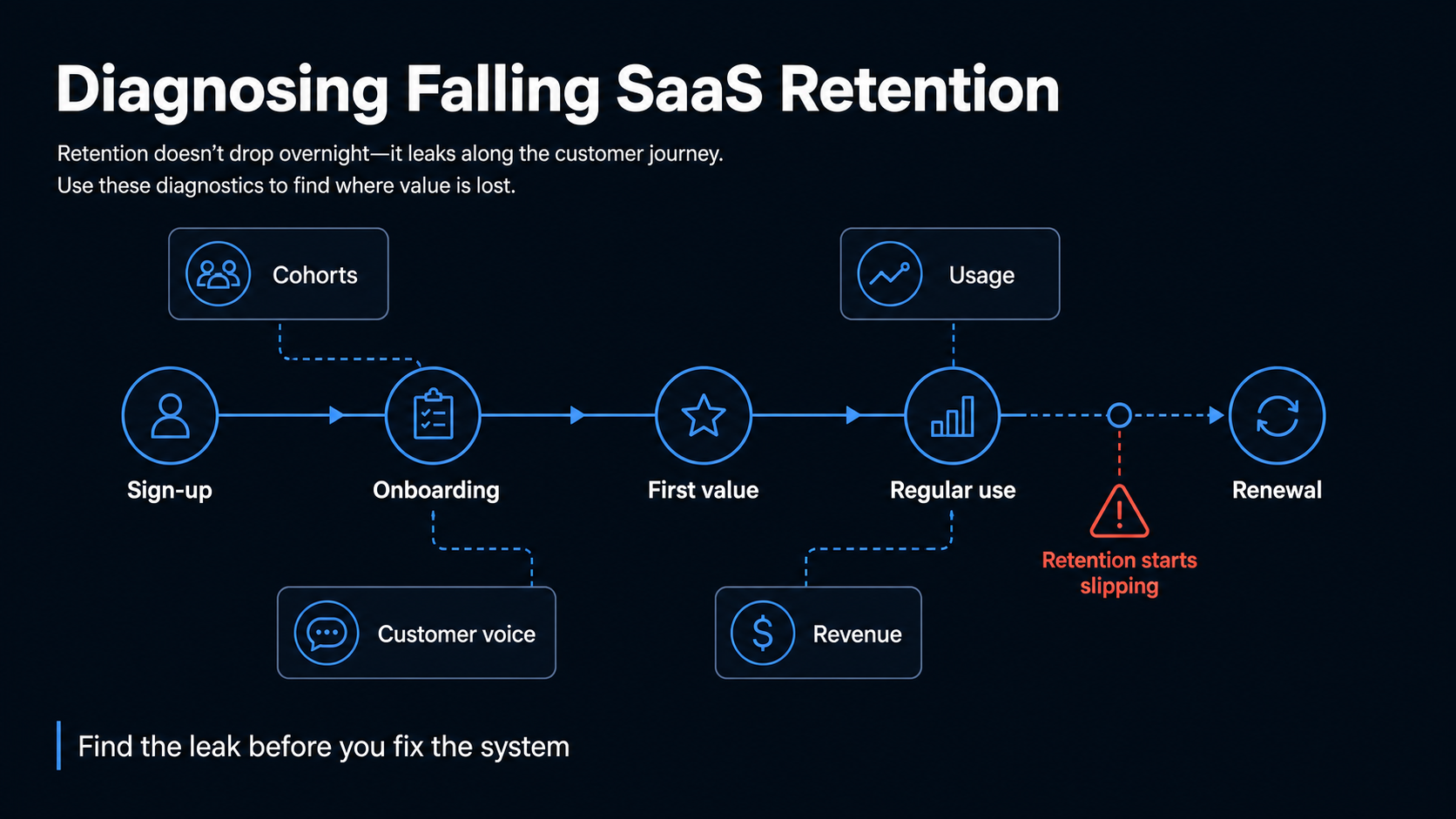
Look at each stage separately, from sign-up through renewal, and check where customers are dropping off. Retention problems usually come from small gaps at specific points in the lifecycle that add up.
Run a cohort analysis first. Group customers by the month they signed up and track how their usage changes over time.
This will show you whether a problem is recent or has been building for a while. Next, look at feature adoption and feature usage.
Are customers actually using the parts of your product that drive value? If core feature usage is low, that’s usually where retention starts to break down.
Review your customer health score. A solid health scoring model combines usage data, support tickets, and login frequency to flag accounts at risk before they churn.
Ask yourself: which accounts haven’t logged in for 14 days? That’s a strong early warning sign.
Don’t skip customer feedback. An exit survey for churned customers tells you why they left, in their own words.
Check your product adoption rates against your customer satisfaction scores. If satisfaction is high but adoption is low, you might have an onboarding problem, not a product problem.
Make sure your analytics tools actually answer these questions. I’ve seen plenty of teams collect data they never use.
If you want a structured look at where your lifecycle is leaking, a proper customer growth and retention audit can help you find the gaps faster than guesswork.
A drop in referrals may be an additional warning signal, particularly when it appears alongside weaker usage, satisfaction or customer engagement.
Key Metrics and Signals to Review First
Start with three numbers: gross revenue retention, net revenue retention, and your customer churn rate. These tell you whether you’re losing customers, losing revenue, or both, and that distinction matters more than most founders realise.
Gross revenue retention (GRR) shows the revenue you’ve kept from existing customers, ignoring upsells. Net revenue retention (NRR or NDR) adds expansion revenue back in, so a strong NRR can mask a weak GRR.
I’ve seen SaaS businesses with 95% NRR that were quietly losing 15% of their customers each year, propped up by a handful of fast-expanding accounts.
Check these first:
Customer retention rate and logo retention — are you keeping accounts, not just revenue?
Monthly churn rate vs revenue churn rate — is it small accounts leaving, or big ones downgrading?
Renewal rate — falling renewals often show up months before churn does
Activation rate and monthly active users — disengaged customers eventually churn
Now look at the money side. Compare your average revenue per user (ARPU) or average revenue per account (ARPA) against customer acquisition cost (CAC).
If your LTV ratio is dropping, retention issues are eating into growth, not just satisfaction.
Finally, check your net promoter score (NPS). It won’t tell you why retention is falling, but a dip usually shows up before the churn numbers do.
In many SaaS businesses I’ve worked with, NRR and GRR benchmarks reveal problems that CAC figures alone would miss.
Practical Fixes for the Next 30–90 Days
Start with the accounts already showing warning signs, not your whole customer base. Pull a list of accounts where usage has dropped, support tickets have spiked, or payment has failed, and work through them in order of revenue at risk.
Fix your dunning process in week one. Failed payments quietly cost customers, so this is your fastest win.
Tools like Stripe or Chargebee let you set up automatic retry logic and email reminders. That way, a card decline doesn't just slip by and turn into a silent cancellation.
I've watched businesses recover a surprising chunk of "lost" customers just by tweaking retry timing and payment email wording. It's not glamorous, but it works.
Next, look at onboarding for accounts that joined in the last 90 days. Did they actually reach the point where the product did something useful for them?
If not, get someone from your team on a call this week. Don't wait until next month.
For existing accounts showing disengagement, skip the generic "we miss you" email. Get specific, ask what changed, what they're trying to do, and where they're stuck.
If you don't have the internal capacity for this, consider a short implementation sprint focused on retention. You can get the right processes in place within weeks instead of months.
Track one number weekly through this period: reactivation rate among at-risk accounts. This tells you if your fixes are actually working.
Onboarding and Time-to-Value Changes
If new customers are taking longer to get value from your product than before, that's usually where falling retention starts. Onboarding is the first thing I check when a client mentions churn creeping up.
Check if your time to first value has increased over the last two quarters. Are customers taking longer to reach that real "aha moment" - the point where they get a tangible result, not just a login?
A few things to look at:
Tutorials and in-app guidance—have these gone stale? Products often add features faster than they update onboarding flows, leaving new users confused by outdated guides.
Team changes—did you lose someone who used to run onboarding calls and replace that personal touch with a generic email sequence?
Sign-up mix—are you attracting a different type of customer now, one who needs more hand-holding than your onboarding was built for?
Here's a simple test: pick ten customers who signed up in the last month and ask how long it took them to get their first real result. If most still say "I'm still setting it up" after two weeks, you've found a problem worth fixing right away.
Retention and Lifecycle Improvements
Fix the lifecycle, not just the churn number. If retention is falling, look at what happens to a customer from day one through renewal and find where the experience breaks down.
Start with customer success. Too often, SaaS businesses treat customer success as a support function, not a growth driver. That's a mistake.
A good customer success team spots warning signs early and builds relationships that make cross-sells and upgrades possible. Quarterly business reviews help here; they give you a reason to check in, review usage, and ask, "Is this still solving the problem you bought it for?"
Build feedback loops into your retention strategy. I've seen SaaS teams collect feedback but never act on it, which is worse than not asking at all. Set up a simple loop: gather feedback, share it internally, act on it, then tell the customer what changed.
Look for upselling and expansion opportunities that make sense. Add-ons and upgrades work best when they solve a problem the customer already has. Track expansion revenue in your CRM so you can see which accounts are ready to grow.
Customer loyalty comes from consistent delivery, honest communication, and treating renewal as something you earn every quarter. You can't just assume it.
Advocacy, Referrals and Customer Proof
Check if your loyal customers are still speaking up for you. If referrals, reviews, and case study requests have gone quiet, that's often a sign satisfaction is slipping before renewal numbers show it.
Advocacy is a lagging indicator of health. Customers rarely refer people or write reviews for a product they're lukewarm about.
In many SaaS businesses I've worked with, a drop in referrals shows up months before churn. Check these three things first:
Referral rate: how many new customers came from existing ones in the last quarter, compared to the quarter before?
Review activity: are customers still leaving reviews on G2, Trustpilot, or Capterra, or has it dried up?
Case study interest: when you ask happy customers to take part in a case study, how many say yes?
If all three have dropped, don't wait for the churn report to confirm what you already suspect. Talk to a few of your most loyal customers directly.
Ask them one simple question: "Would you still recommend us to a peer, and why or why not?" Their answer will tell you more than any dashboard.
This isn't just about chasing testimonials. It's about using customer advocacy as an early warning system for retention problems, because the customers who'd normally champion you are usually the first to notice when something's off.
Common Mistakes to Avoid
The biggest mistake? Looking at your product first and your customers last. Retention problems usually start with a mismatch between who you sold to and who you should have sold to.
I've seen SaaS teams spend weeks tweaking features when the real issue was poor fit at the point of sale. If your sales team is closing anyone with a credit card, you'll always leak customers out the back.
Here are mistakes I see over and over in retention reviews:
Treating onboarding as a one-off task. A single welcome email isn't onboarding. That's just ticking a box.
Waiting for support tickets instead of watching usage. By the time someone emails you, they've often already decided to leave.
Ignoring your power users. These customers can tell you what's working, but most teams only talk to unhappy ones.
Reacting to churn instead of predicting it. Do you know which accounts are at risk this month, or do you only find out after they've cancelled?
Another mistake: running retention as a support function, not a growth one. Too often, the customer success team gets the smallest budget and the least attention from leadership…even though they're managing the revenue you already have.
And don't confuse activity with progress. Sending more emails or adding more in-app messages isn't a strategy if you don't actually know why customers are leaving in the first place.
When to Bring in Outside Help
Bring in outside help when you've tried the obvious fixes and retention still isn't moving. Or when you don't have the time or headcount to do a proper diagnosis yourself.
I've seen founders spend months tweaking onboarding emails when the real problem was upstream, in how customers were sold to in the first place. A fresh pair of eyes can spot that faster than someone too close to the product.
Here are signs it's time to get outside support:
You've made changes, but churn hasn't shifted in two or three months
Nobody owns retention as a proper job, it's split across support, product, and sales
You're guessing why customers leave instead of knowing
Your team is stretched thin and retention keeps slipping down the priority list
If any of those sound familiar, a customer-led growth audit can give you a clear view of what's actually going wrong before you spend more money guessing.
For businesses that need ongoing leadership but can't justify a full-time hire, fractional customer-led growth support is worth considering. You get senior input on retention strategy without the cost or commitment of a permanent role.
If you can't answer why your last ten cancelled customers left, you probably need outside eyes on the problem. Guessing gets expensive.
Frequently Asked Questions
Here are the practical questions I get asked most often when retention starts slipping. Some are about benchmarks, some are about diagnosis, and some are about what actually moves the needle.
What is a good SaaS retention rate for a business at our stage?
There's no single number that works for every business, so ignore anyone who tells you 90% is the bar. It depends on your contract size, whether you sell self-serve or enterprise, and how mature your product is.
If you're a self-serve SMB tool, gross logo retention in the 80–85% range might be perfectly healthy. Selling six-figure enterprise contracts? Anything below 90–95% should worry you, because losing one customer costs you a lot more.
The more useful benchmark is net revenue retention. This shows whether your existing customers are growing or shrinking in value once you account for churn, downgrades, and upsells.
I've seen businesses obsess over logo retention while their NRR quietly slides below 100%. That means their existing base is contracting even if most customers are staying.
Compare your numbers against businesses with a similar average contract value, not against the industry as a whole.
How do we identify whether churn is caused by onboarding, product value or customer support?
Look at when customers churn, not just why they say they're leaving. The timing tells you more than the exit survey does.
If churn clusters in the first 30–60 days, it's almost always an onboarding problem. Customers never got to the point where the product actually did the job they bought it for.
If churn happens later, after months of use, it's usually a value or engagement problem. Usage might have started strong and then faded, which points to the product not delivering enough ongoing reason to stay.
If customers are still logging in and using the product but still leave, look hard at support. In many SaaS businesses I've worked with, unresolved friction (slow response times, unfixed bugs, no clear escalation path) pushes otherwise engaged customers out the door quietly.
Pull churned accounts into three buckets by timing and cause, then check which bucket is growing fastest. That tells you where to spend your time first.
Which customer segments are driving the biggest fall in retention?
Break your churn down by plan tier, contract size, industry, and acquisition channel before you do anything else. A blended churn number hides where the real damage is happening.
I've seen businesses assume they had a broad retention problem when actually it was one segment, usually customers acquired through a specific channel or a particular plan tier, dragging the average down. Everyone else was retaining fine.
Try this: take your churned accounts from the last two quarters and group them by how they were acquired (paid ads, referral, sales-led, self-serve sign-up). Then compare retention rates across those groups.
If one channel is churning at twice the rate of the others, you've probably got a targeting or expectations-setting problem, not a product problem.
Do the same by company size or use case if you sell to businesses. Smaller customers often churn for different reasons (budget, low usage) than larger ones (poor onboarding, weak stakeholder buy-in).
What leading indicators show that customers are at risk of churning?
Behavioural signals tell you far more than surveys do. Instead of waiting for an NPS score to drop, watch login frequency, feature activation depth and workflow completion.
Here are a few signals worth tracking:
Declining session depth – customers still log in but only check one thing before leaving. It's a quieter warning than customers who stop logging in altogether.
Falling seat utilisation – when a team buys 20 licences and only 5 people use them, that's a strong sign a downgrade or churn is coming.
No integrations connected – accounts without third-party integrations usually have lower switching costs, so they're easier to leave.
Support tickets that spike then go silent – sometimes this means the issue got fixed, but sometimes the customer just gave up and stopped asking.
The businesses I've seen do this well check these signals weekly for their highest-value accounts. Don't wait until renewal time. If a customer tells you they're not renewing, you've probably missed your chance to change their mind.
How should we calculate gross revenue retention and net revenue retention?
Gross revenue retention (GRR) shows how much recurring revenue you kept from existing customers, ignoring upsells or expansion. Start with your revenue from a cohort, subtract churn and downgrades, then divide by the starting figure. GRR can't go above 100% because it doesn't include growth.
Net revenue retention (NRR) works differently. It includes upsells and expansion, as well as churn and downgrades. Start with your revenue, subtract churn and contraction, add expansion revenue, then divide by the starting figure. If your NRR is over 100%, your existing customers are generating more revenue than last year, even without new sales.
For example, if a cohort starts with £100,000 in recurring revenue, loses £15,000 through churn and contraction, and gains £10,000 through expansion, GRR is 85%, and NRR is 95%. GRR ignores expansion; NRR includes it.
Track both. GRR shows how sticky your product is. NRR shows how well you're growing the accounts you keep.
What role do customer relationships and community play in improving SaaS retention?
Strong customer relationships and an active community give you two things that directly affect retention: early warning signals and increased switching costs.
Neither is a nice-to-have.
When customers feel connected to your team or to other users, they're way more likely to speak up when something's off. I've seen support tickets and community posts flag product issues weeks before they showed up in churn numbers, just because people felt comfortable raising them instead of leaving quietly.
Community does something subtler too. If a customer builds workflows, relationships, or even a bit of reputation within your community, switching to a competitor means starting from scratch.
That's a real cost, not just an emotional one.
Use relationships and community as a data source, not just a feel-good initiative. Ask yourself: which customers are most active in your community or most engaged with your team, and how does their retention compare to customers with no relationship at all?
If the gap is significant, you've found a lever worth investing in properly.
Have you seen this in your own business? I’m always interested in hearing what teams discover when they look more closely at retention, customer insight and advocacy. Connect with me on LinkedIn or book in for a call today