Why are our SaaS customers churning after the first few months?
You've probably noticed it: customers sign up, use your product for a few weeks, then quietly disappear. Most early churn in SaaS happens because customers never reach the point where your product becomes part of their routine, not because your product is bad.
That gap between signing up and actually getting value is where you lose people.
This article walks you through why early churn matters more than founders often realize. You'll see what it usually looks like in practice and the common root causes behind it in SaaS, subscription, and tech businesses.
You'll also get a practical framework for diagnosing your own customer lifecycle. I’ll cover the key metrics worth checking first and specific fixes you can try over the next 30 to 90 days.
I'm Jonny Quirk from Community Rocket. All this comes from working with SaaS, subscription, and tech businesses on customer-led growth, retention, and turning customers into advocates.
If you run a B2B SaaS business and you're losing customers before they've had a real chance to see the value, figuring out why is your first step to fixing churn for good.
The TL;DR
Early customer churn usually means people aren't reaching real value fast enough, not that your product is broken.
Checking specific onboarding and engagement metrics helps you spot where customers are dropping off.
Small, targeted changes to onboarding, lifecycle communication, and customer proof can seriously improve retention within a few months.
Why Early Customer Churn Needs Addressing
Early churn costs you far more than a lost subscription. It wrecks the maths behind your entire growth model.
Every customer you lose in the first few months is one you've already paid to acquire. Your customer acquisition cost (CAC) doesn't disappear just because they left…you've spent the money on ads, sales time, and onboarding, and got nothing back.
In many SaaS businesses I've worked with, this gets ignored until someone finally does the maths. If a customer's lifetime value (LTV) doesn't clear your CAC within a reasonable window, you’re not growing. You’re just churning through cash.
Early churn shrinks that LTV fast, which drags your LTV to CAC ratio down with it. It also hits your monthly recurring revenue (MRR) twice.
You lose the recurring revenue from the churned account, and you lose the chance to grow it through upsells or expansion revenue later on.
Ask yourself: what would happen to your growth targets if you simply kept 20% more of your new customers past month three? For most founders, that’d mean hitting your numbers with less spend.
Fixing early churn is usually a better use of time than chasing new leads. You already have the relationship, you just need it to hold.
Common Symptoms of an Early Churn Problem
You'll usually see the same pattern before customers leave: low product use, missed setup steps, and quiet support tickets that never get raised.
These are your early warning signs, and they show up weeks before someone actually cancels. I’ve watched this play out the same way across dozens of SaaS businesses.
The customer signs up, logs in a few times, then goes quiet. No complaints, no fanfare. Just silence.
Here's what to check for:
Low login frequency after the first two weeks
Key features never activated, especially ones your best customers use daily
No response to onboarding emails or check-in calls
Support tickets that stop, even though usage is dropping
That last one catches people out. You might think fewer tickets means fewer problems, but often it means the customer has stopped trying.
Your annual renewal date is another useful marker. If an account is quiet three months before renewal, that's a strong signal of churn risk, not a coincidence.
A simple metric worth tracking: how many customers reach "first value" (the moment they get real use from your product) within their first 30 days?
In many SaaS businesses, this number predicts churn better than any support score. Build a short list of at-risk accounts every month based on usage data.
It doesn't need to be complicated, just consistent. You're looking for the accounts drifting quietly away, not the ones shouting about problems.
Root Causes in SaaS, Subscription and Tech Businesses
Most churn in SaaS and subscription businesses comes down to a gap between what you promised and what customers actually experience. I’ve seen this play out in a few common ways.
Voluntary churn is when a customer chooses to leave. Usually it's a value gap…they signed up expecting one thing and got something else.
This often traces back to weak product-market fit, or a value proposition that oversold the benefits. Involuntary churn is different.
This is when a customer wants to stay but leaves anyway because of failed payments. A card expires, a payment fails silently, and the account cancels without anyone noticing.
Fixing involuntary churn is often the quickest win you’ll find. Check your dunning process…do you retry failed payments automatically, and do you email the customer before you cancel them?
Missing features and a slow product roadmap also drive churn. If customers keep asking for something you never build, they'll find a competitor who has it.
Poor user experience matters more than most teams admit. A clunky interface makes customers feel like the product is hard work, even if it does the job.
Switching costs can mask churn risk for a while. High switching costs, like annual contracts or annual billing, buy you time but don’t fix a bad customer experience; they just delay the cancellation until renewal.
The businesses that keep customers longest treat product development as an ongoing conversation with users, not a guessing game.
How to Diagnose Your Customer Lifecycle
Diagnose your customer lifecycle by mapping every stage a customer goes through and checking where engagement drops off.
This tells you if your churn problem is really an onboarding problem, a value problem, or something else entirely. Start with your data.
Pull usage patterns from tools like Mixpanel or Google Analytics. See what active customers do differently from those who leave.
I've seen many SaaS businesses assume they have a product problem when the real issue is that customers never reach the point where the product clicks for them.
Behavioural data only tells you what happened, not why. That's where customer feedback comes in.
Run exit interviews with customers who've just cancelled. Ask them plainly: what were you trying to achieve, and where did we fall short?
Their answers, along with feature requests from your support tickets, often reveal patterns you won’t spot in a spreadsheet. Break your customer journey into clear stages:
Sign-up to first value – did they reach an outcome quickly?
Early usage – are they using core features regularly?
Ongoing engagement – is usage steady or declining?
Renewal or churn – what triggered the decision?
Once you’ve got this mapped, churn analysis gets much easier. You can spot where customers stall and test fixes at that stage.
For more advanced diagnosis, churn prediction software using predictive analytics can flag at-risk accounts before they leave, giving your team time to step in.
If you want a structured way to map this out, a customer lifecycle audit can help you find the exact stage where retention breaks down.
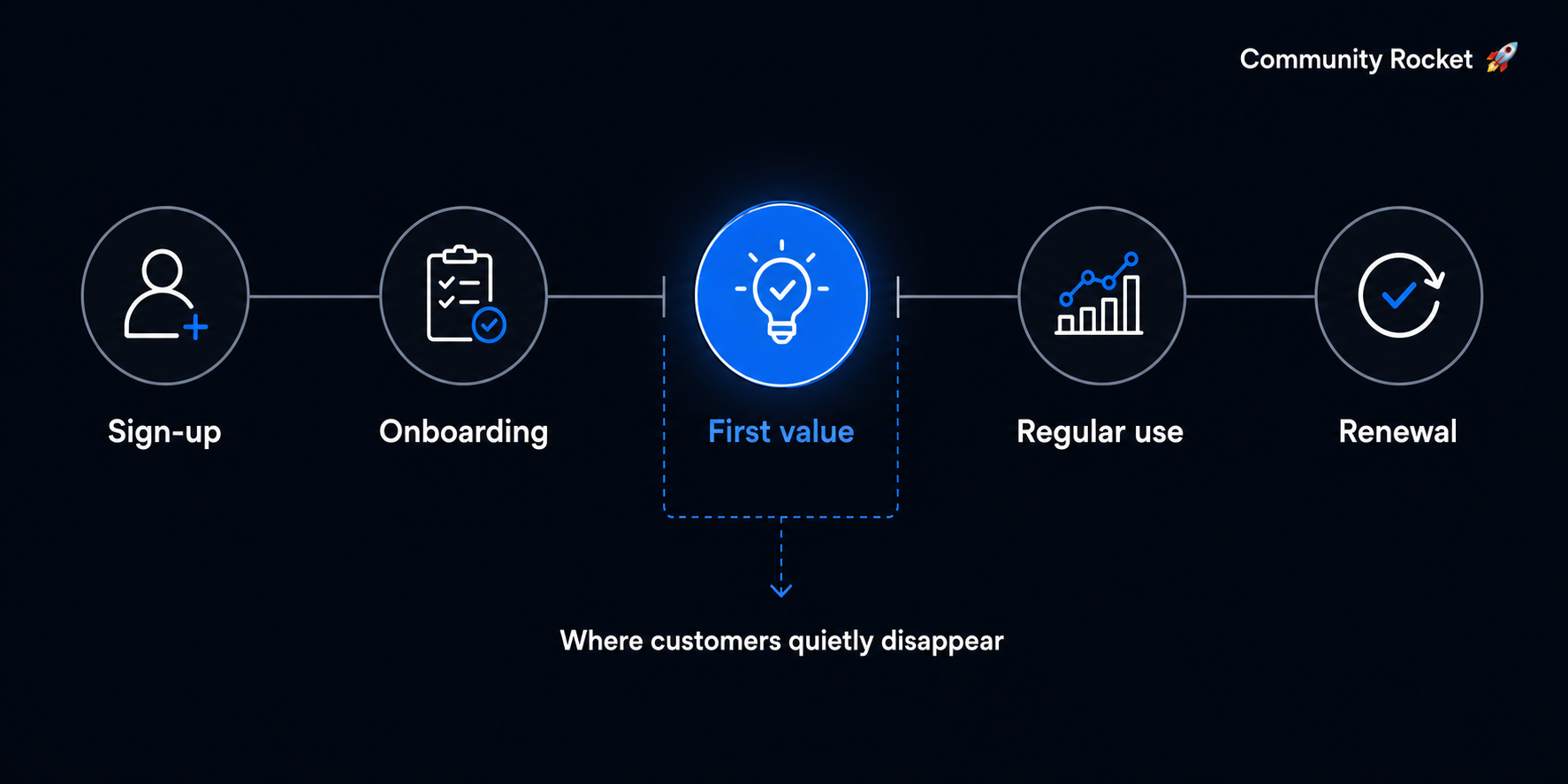
The most important early-retention question is whether customers reach a meaningful first outcome before they lose momentum.
Key Metrics and Signals to Review First
Before you can fix churn, you need to know where it's actually happening. Start with the numbers, then look for the behaviour behind them.
Check your monthly churn and annual churn rates first. Compare these against SaaS churn rate benchmarks to see if you're within a normal range or bleeding customers faster than most.
Then split revenue churn from customer count churn. A high MRR churn figure alongside low customer churn often means your bigger accounts are the ones leaving, which is a different problem to solve.
Look at net revenue retention (NRR) too. If NRR sits below 100%, expansion revenue isn't covering what you're losing, and that's worth flagging early.
Next, pull your product usage data. Login frequency, session duration, and feature adoption rate tell you whether customers are actually getting value, not just paying for it.
I've seen accounts churn quietly for weeks before cancelling, simply because usage dropped off and nobody noticed. Support ticket patterns matter too.
A spike in tickets, or silence from an account that used to raise them regularly, are both churn signals worth investigating. Finally, check billing data in tools like Stripe for failed payments or downgrades.
Layer in NPS scores or customer satisfaction surveys. Ask yourself: has this customer's engagement level dropped in the last 30 days?
That single question often points you straight to the answer.
SEOAnt - Lessons Worth Learning…
SEOAnt, a SaaS SEO tool, saw early churn as high as 45% when it first launched. The problem wasn’t the product…it was who they were selling it to.
SEOAnt had built a tool best suited to e-commerce stores doing dropshipping on Shopify. But they marketed it to all online stores.
New customers signed up, tried the free plan, and realised it didn't fit their needs. So they left, often within the first few weeks.
This is a classic case of poor customer fit, one of the most common reasons SaaS customers cancel. I’ve seen this pattern in other SaaS businesses too.
You chase sign-ups from anyone who'll take them, then wonder why half of them vanish by month two. SEOAnt's fix was straightforward.
They narrowed their target audience to Shopify dropshipping stores specifically, and paired that with a proper onboarding process. The result was a churn reduction of 78%.
The churn that remained shifted from early-stage to late-stage. That shift matters.
Late-stage churn from customers who’ve had time to get value is a different problem to early churn from customers who never should have signed up. Ask yourself: are you attracting the right customers, or just more customers?
If your early churn is high, check who's cancelling and whether your product actually fits what they need. Sometimes the answer isn’t a better onboarding flow; it’s a narrower, sharper sales pitch.
Practical Fixes for the Next 30–90 Days
You fix early churn by acting on warning signs before day 90, not after the cancellation email hits your inbox.
This means tightening onboarding, watching usage data, and stepping in early when accounts go quiet.
Start with an early warning system.
Track logins, feature use, and support tickets weekly for every new account.
If usage drops for two weeks straight, that's your cue to call, not wait.
Look at your first 30 days closely.
In a lot of SaaS businesses, the biggest drop-off happens when customers don't reach a "first win" quickly enough.
What's the one action that proves a customer is getting value?
Make sure every new user hits that milestone in week one.
Simple fixes that work:
Send a check-in message on day 14, not day 60
Flag accounts with zero logins in 7 days for a personal outreach and an invite to an activation.
Build a short survey into your cancellation flow to learn why people leave
Set a target: aim for 80% of new customers reaching your key feature within 14 days
For churn prevention to stick, you need consistent effort, not just a one-off campaign.
If your team is stretched, running a focused implementation sprint over six to twelve weeks can help you build these habits properly.
Onboarding and Time-to-Value Changes
Customers churn when they never get to a meaningful outcome quickly enough.
If onboarding drags or doesn't clearly show value, people lose interest before they've had a reason to stay.
I've seen this play out the same way in dozens of SaaS businesses.
A customer signs up, gets a login, and then... not much happens.
No clear path to a result, so they drift off and quietly stop using the product.
The fix starts with your onboarding experience.
What's the one thing a new customer needs to do to see real value?
Not "log in" or "explore the dashboard", something specific, like sending their first campaign or connecting their first data source.
This is often called time-to-value, and it matters more than most teams realise.
In many SaaS businesses, customers who hit that first value moment within 14 days stick around far longer than those who don't.
Feature adoption should follow a clear sequence, not a scattergun tour of every button in your app.
Build in success milestones that customers can actually see themselves hitting, things like "first report generated" or "team invited."
Ask your team each week: how many new customers reached their first milestone this week, and how many didn't?
That single number tells you more about future churn than almost anything else you'll track.
Retention and Lifecycle Improvements
You fix early churn by building a proper retention strategy.
This means mapping out what should happen at each stage of the customer lifecycle and making sure it actually happens.
Start with your customer success function, even if that's just one person right now.
Their job is to spot warning signs before a customer cancels, not just respond after they've decided to leave.
Proactive outreach matters more than most founders think.
The difference between customers who stay and customers who leave often comes down to whether anyone from the company reached out during month two or three.
Set up simple triggers for this.
If a customer hasn't logged in for two weeks, someone should get in touch.
If usage drops by 50%, that's a signal too.
Your high-value customers deserve a named contact, whether that's a dedicated CSM or a founder who checks in personally.
This builds a real customer relationship, not just a transactional one.
Tools like HubSpot or Intercom can help you run re-engagement campaigns for customers who've gone quiet, but don't rely on automation alone.
Ship product updates that solve real problems customers have raised, then tell them directly.
This shows you're listening, which drives customer engagement and strengthens customer retention over time.
Advocacy, Referrals and Customer Proof
Missing advocacy doesn't cause early churn directly, but it's often a sign that customers never felt strongly enough about your product to stick around.
If nobody wants to recommend you after three months, that says something about the value they're getting.
I've seen this pattern a lot.
Customers who leave positive reviews or agree to a reference call rarely churn soon after.
They've had a moment where the product proved its worth, and that moment tends to anchor them.
Build advocacy into your onboarding, not just your renewal process.
Ask new customers a simple question at day 30: "Would you recommend us to a colleague, and why or why not?"
The answer tells you whether they're on track or already drifting.
Don't wait for happy customers to volunteer.
Most won't, even if they're satisfied.
According to SaaS customer advocacy best practice, the sequence matters: deliver value first, then ask for advocacy once they've felt it, not before.
A few things worth tracking:
Referral rate in the first 90 days
Review requests sent versus completed
Reference call willingness as a proxy for satisfaction
If a customer won't agree to a two-minute review or a short call, that's a warning sign worth investigating before renewal, not after.
Treat advocacy as an early indicator of retention risk, not just a marketing nice-to-have.
The mistakes that keep churn high
The biggest mistake you can make is treating every cancellation as a product problem.
Most churn happens before a customer ever finds a genuine gap in the product.
It's usually caused by poor targeting, weak onboarding, or a value story the customer can't justify to their boss.
Here are the traps I see founders and teams fall into again and again.
Jumping straight to the roadmap.
A customer cancels, someone asks what feature was missing, and product builds it.
Six months later, churn hasn't moved because the real driver was never a missing feature at all.
Ignoring when customers leave.
If people cancel in week two, that's a different problem from people cancelling at renewal.
Look at your cohort data before you decide what to fix.
Rewarding sales for closing the wrong customers.
If reps hit quota by signing people outside your ideal customer profile, you'll keep seeing strong sign-ups next to poor retention.
That's not a coincidence.
Skipping exit interviews.
Ten short calls with churned customers will teach you more than a dashboard.
Ask them what a normal day with the product looked like, and listen for the difference between "I never got into it" and "I couldn't justify the cost."
Fixing everything at once.
Positioning, onboarding, value delivery, and product gaps all need different owners and different timescales.
Trying to solve all four together usually means none of them get fixed properly.
When to Bring in Outside Help
Bring in outside help when your team knows churn is a problem but doesn't have the time, data skills, or experience to fix it properly.
This usually happens once you've grown past the point where one founder or customer success manager can keep track of every account.
In many SaaS businesses, the warning signs are the same.
You're relying on gut feeling instead of data.
Nobody owns retention as a proper job.
Or you've tried a few fixes, like better onboarding emails, but churn hasn't moved.
Ask yourself these questions:
Do you know exactly which customers are at risk this month, and why?
Does anyone in your business own customer retention full-time?
Have you tested and measured changes to onboarding, or just guessed?
If you answered no to any of these, that's a sign you need support.
This doesn't always mean hiring a full-time head of retention.
A fractional head of customer-led growth can do the job part-time, bringing structure and accountability without the cost of a permanent senior hire.
If you're not ready for ongoing leadership, start smaller.
A focused audit can show you exactly where customers drop off and why, before you commit to bigger changes.
Community Rocket's customer growth services include audits and short implementation sprints built for this.
You get clear findings and a plan you can act on straight away, without a long contract or a big team.
Going Deeper…
Below are the questions I get asked most often when SaaS founders come to me trying to work out why customers leave in the first few months.
Each answer gives you a straightforward, practical way to think about the problem.
What are the most common reasons customers cancel a SaaS subscription after the first 90 days?
Most customers leave because they never got to the point where the product proved its worth.
In many SaaS businesses I've worked with, this shows up as customers leaving in the first 90 days before they've had a proper chance to see results.
The usual suspects are poor onboarding, a mismatch between what was sold and what was delivered, and pricing that feels too steep once the novelty wears off.
I've also seen champion turnover cause problems, where the person who bought the product leaves the company, and nobody else picks up the relationship.
Competition matters too.
If a rival product does the same job for less money or with less hassle, customers won't stick around out of loyalty alone.
How can we tell whether early churn is caused by poor onboarding, weak product value or pricing?
You need to talk to the customers who leave, not just look at dashboards.
Ask them directly: "What were you hoping this would do for you, and did it get there?"
If customers say they never understood how to use the product properly, that points to onboarding.
If they understood it fine but it didn't solve their problem, that's a value issue.
If they liked it but felt it cost too much for what they got, that's pricing.
Check when in their journey they cancelled.
A customer who quits in week two probably never got set up properly.
One who quits in month three, after using the product regularly, is more likely to have hit a value or pricing wall.
Which customer health signals should we track in the first few months to spot churn risk?
Login frequency is the obvious starting point, but it's not enough on its own.
You want to track whether customers are reaching the specific actions that matter for your product, not just whether they're logging in.
For example, if you run a project management tool, tracking whether a customer has created their first project isn't as useful as tracking whether they've invited teammates and assigned tasks.
That second behaviour shows the product has become part of how they actually work.
Other signals worth watching include support ticket volume (too many tickets early on suggests confusion), feature adoption rates, and whether the original buyer is still the main point of contact.
A drop-off in any of these in month two or three is worth a proactive check-in call.
How do we improve activation so customers reach value before their renewal decision?
Map out the smallest number of steps a customer needs to take to get real value. Build your onboarding around getting them there fast.
Don't wait for them to discover it themselves. I've seen SaaS companies cut early churn by shrinking the gap between signup and the so-called "aha moment."
If it takes a customer three weeks to see results, ask yourself what's slowing them down. Remove those blockers.
This could mean assigning a dedicated onboarding contact for the first 30 days. Or, maybe you build in-app prompts that nudge customers toward the actions that actually matter.
The goal? Get them to value before they've had time to wonder if the subscription's worth it.
What role do customer relationships and community play in reducing early-stage churn?
Relationships give you two things: early warning signs and a reason for customers to stay engaged when things go quiet. A customer who knows their account manager by name is far more likely to raise a concern before cancelling than someone who's never spoken to anyone at your company.
Community works in a similar way, just at a bigger scale. When customers see how others use your product, ask questions, and share tips, they get answers a lot faster than waiting on support tickets.
This directly affects how quickly they reach value. I've seen community act as an early warning system, too.
If several new customers post the same confused question in a forum, that's a clear sign your onboarding has a gap. Usually, you'll spot this before it shows up in your churn numbers.
How should we segment churned customers to find the biggest retention opportunities?
Group churned customers by why they left, not just when. This matters because the real cause of churn is often misdiagnosed.
Teams sometimes assume it's a product issue, but sometimes the problem starts with expectations set during sales. That early misunderstanding can set the stage for disappointment later.
Break churned customers into categories like never activated, activated but didn't see value, price-sensitive, and lost their internal champion. Each group needs its own fix.
If you treat everyone the same, you end up wasting effort. It's better to meet people where they are, right?
Once you've got these groups, check which one is biggest and which one you can realistically fix. A small group of price-sensitive folks might just need a different package.
But if you see a big pile of customers who never activated, that probably means onboarding needs work. That's where I'd start.
Hope you’ve found this helpful!
Have you seen this in your own business? I’m always interested in hearing what teams discover when they look more closely at retention, customer insight and advocacy. Connect with me on LinkedIn or book in for a call today